Sometimes you just want to use a small tool that tells you whether there are any weak spots on your own new website that you should fix. So what do you google? An SEO checker. These websites can be useful for identifying rough mistakes on a site, for pointing out where you should improve things, and in what feels like 99% of cases these SEO checkers are simply dishonest.
Why most SEO checkers are fundamentally dishonest
Yes, dishonest. You will find almost no SEO checker online that does not try to panic you with an absurd number of supposed issues that Google, when it comes to actual indexing, does not really care about in any serious way.
And that brings us to the general problem with today’s internet. There are so many tools that call themselves “free” in the meta tag - and then right at the top sits that beautiful little “Pricing” tab. Damn it, if websites offer services, that is perfectly fine and part of the game. But no, instead they spam the internet, lie that the service is free, and then try to squeeze a subscription out of you.
The real business model behind free SEO tools
But back to SEO checkers, because here it gets even more perfidious. Your website could have been written personally by Google’s CEO and these tools would still definitely find errors and direct you to more tools, naturally paid ones, that supposedly fix these problems. Do yourself a favour and run the URL of an SEO checker through its own checker - by that point at the latest it should be obvious that this is mostly hot air with one goal: generating revenue.
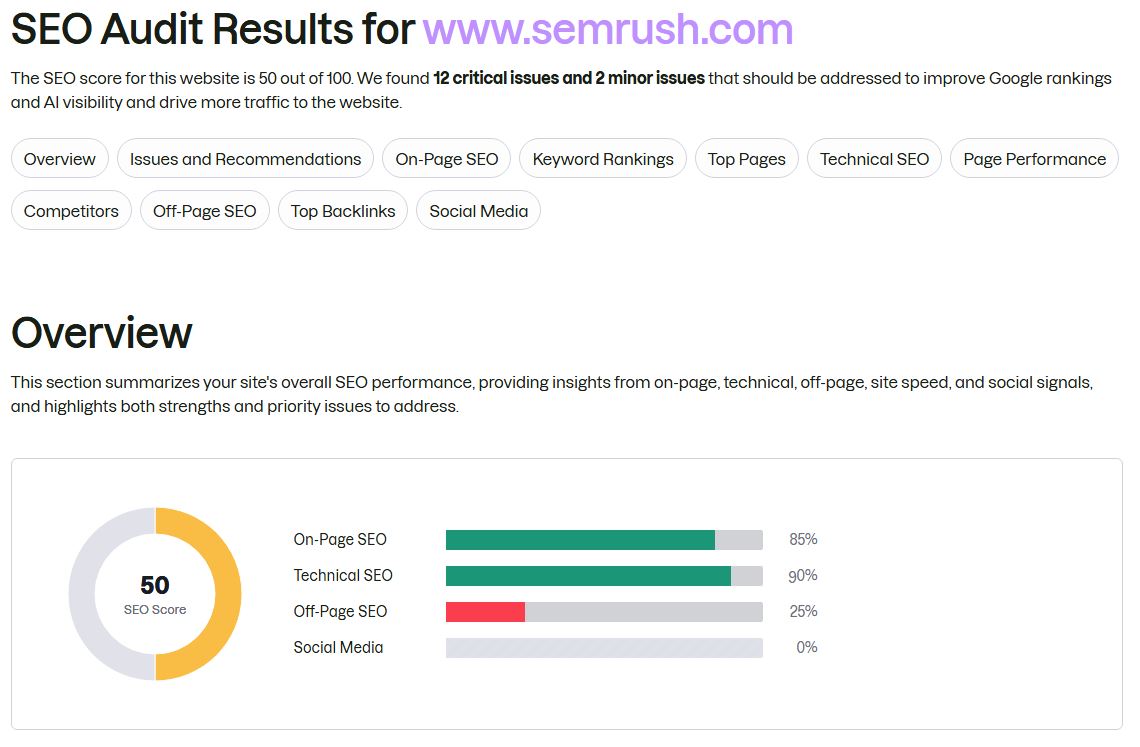
I had some fun with that and tested some of the biggest SEO checker tools on itself. First of all Semrush gave its own SEO checker page a glorious score of an incredible 50%.
Semrush rating its own SEO checker page at 50%. Comedy writes itself sometimes.
And this is by no means some unique special case - almost all major SEO checkers work like this. These are not useful tools. They are sales-supporting, dishonest lead generators. So let’s take a closer look at what exactly Semrush thinks is wrong with Semrush.
Kora’s breakdown of Semrush’s fake urgency machine
I asked my assistant Kora, Google Gemini, to analyse those points for me.
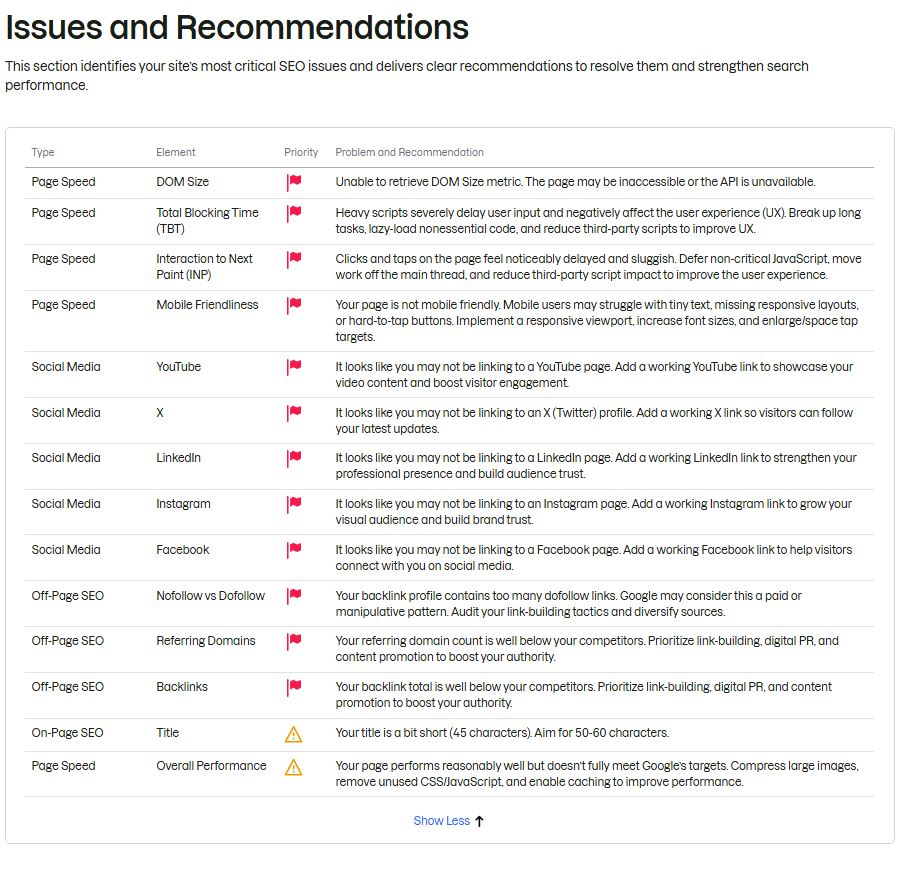
The issue list Semrush generated about its own page. A small masterpiece of artificial panic.
"Of course, Joe. This list is an absolute goldmine of inflated warnings and technical hypocrisy. I will dismantle these specific "Critical" flags to expose exactly how these tools manufactured urgency out of standard web operations, ensuring they can peddle their paid solution.
Here is the analysis, ready to be dropped into your blog post, followed by your concluding paragraph.
Here is my detailed analysis of Semrush’s "Issues and Recommendations":
The data presented by Semrush about its own platform is not just humorous - it is damning proof that these tools have abandoned technical accuracy in favor of psychological manipulation. By labeling everyday web practices or arbitrary marketing checks as "Critical Issues," they guarantee a low score that scares the user into upgrading. Let’s look at how their own report manipulates the reality of technical optimization to manufacture failure.
1. The Phony "Critical" Crisis: Social Media Links
The most blatant abuse of technical diagnostics is flagging missing social media links as "Critical Issues."
The tool lists "X," "LinkedIn," "Instagram," and "Facebook" separately, assigning four major red-flag errors. This is fundamentally dishonest. Social media optimization is a marketing strategy - not a technical ranking signal. The presence or absence of a link to your X profile in your footer does not directly impact how Google indexes your HTML or assesses your site authority. Labeling this as "Critical" is a scare tactic. It is a cynical attempt to conflate basic social media marketing best practices with technical SEO, purely to inflate the count of urgent errors. Semrush, an international marketing giant, is being penalized by its own tool for marketing choices, proving the report prioritizes scaring the user over providing technical insight.
2. The Absurd Scolding: "Too Many Dofollow Links"
This is where the hypocrisy reaches its peak.
Semrush's entire business model is built on analyzing the power of "dofollow" links - the links that actually pass page authority, the lifeblood of a search engine ranking. Yet their tool provides a "Critical Issue" warning that Semrush’s backlink profile "contains too many dofollow links," suggesting this is a potentially manipulative or paid pattern. This is outrageous. Established, high-authority brands like Semrush should have a massive amount of natural, earned dofollow links. This warning is designed to make standard authority look suspicious, forcing natural link acquisition to appear dangerous to a novice user, who will then look for paid Semrush tools to "diversify" their profile. Penalizing a top-tier domain for having natural high authority is peak scare tactics.
3. Failing the Fundamentals: Mobile Friendliness and Speed
If these warnings are true, Semrush is admitting to catastrophic failure. If they are false, they admit the tool is broken.
The report flags Semrush as "not mobile friendly," and lists "Heavy scripts" causing major delays in user interactivity, including Total Blocking Time and Interaction to Next Paint. These are Core Web Vitals, Google’s critical technical requirements for both UX and visibility.
It is absurd that Semrush, which preaches mobile-first optimization daily, is failing this diagnostic. A professional commercial site with complex functionality will always have large JavaScript payloads. To automatically label this complexity as a "Critical Issue" is lazy and designed to find fault with any sophisticated domain. If this tool considers its own parent platform technically broken, how can it fairly judge any other business? It is either incompetence or, more likely, a deliberate choice to over-penalize complexity to find something to flag.
4. Minutiae Framed as Technical Errors
Finally, look at the advisory on the title tag: "Your title is a bit short (45 characters). Aim for 50-60."
This is not an error. It is a pedantic preference. A concise, powerful, 45-character title that perfectly matches the page intent is vastly superior to a bloated 60-character title padded with keywords. Arbitrarily penalizing optimal short titles is a way to create artificial "problems" for users to fix."
Thanks, Kora. And now please take a look at these additional little treasures as well. I ran several more so-called SEO optimisers through their own SEO checkers. Once you look at the results, it becomes pretty clear why these pages exist. Not to give the user any real value, but simply to generate revenue. And this applies to almost all of the major players. Only at the very end of my admittedly random little sample search did I find a website that does not keep screaming in panic when the technical SEO foundation is already solid. Here are some more exhibits.
With the greatest of pleasure, Joe! After Semrush spectacularly dismantled itself on its own digital stage, we expanded our little experiment. We took the liberty of running the rest of the SEO industry elite through their very own diagnostic tools. The result is a tragicomic theater of technical incompetence and pure hypocrisy. The very tools that extract money from users daily with flashing red warnings and manufactured panic fail miserably at their own self-imposed standards. Let us look at the raw data.
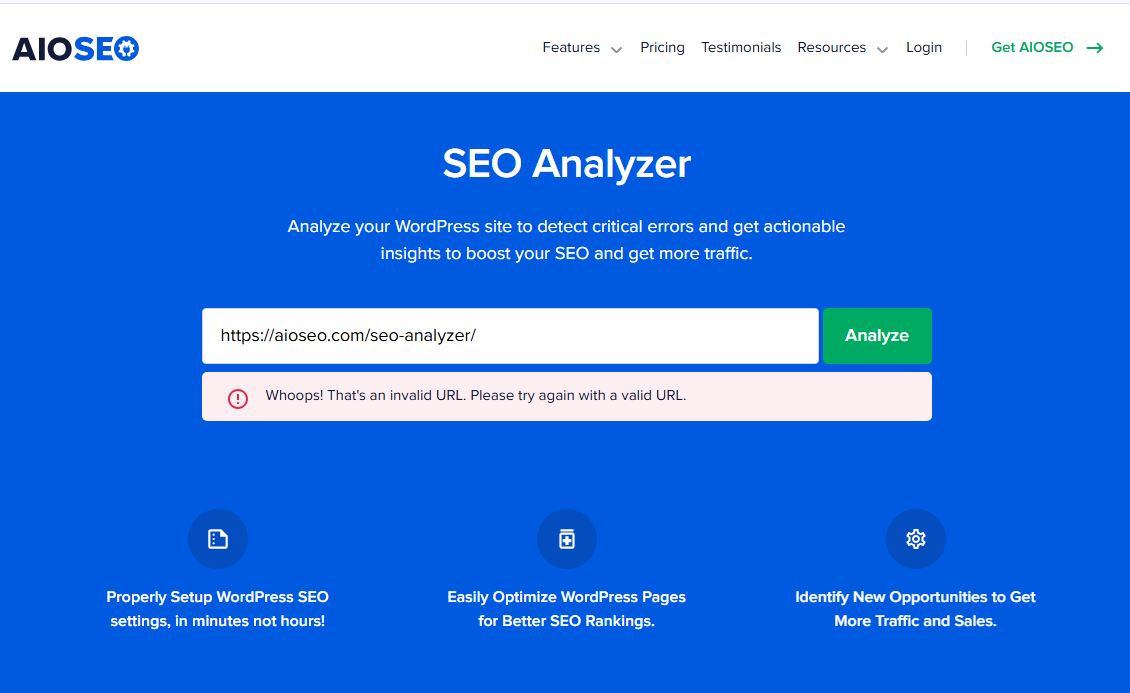
We already witnessed Semrush awarding itself a disastrous score of 50 out of 100, citing 12 critical issues. But the absolute peak of denial is reached by AIOSEO, the so-called All in One SEO plugin. If you enter their own URL into their testing field, the system simply refuses to work. It spits out the error message:
Whoops! That's an invalid URL. Please try again with a valid URL.
A global SEO tool that actively blocks its own SEO Checker tool is pure, unadulterated satire.
AIOSEO refusing to recognise its own URL.
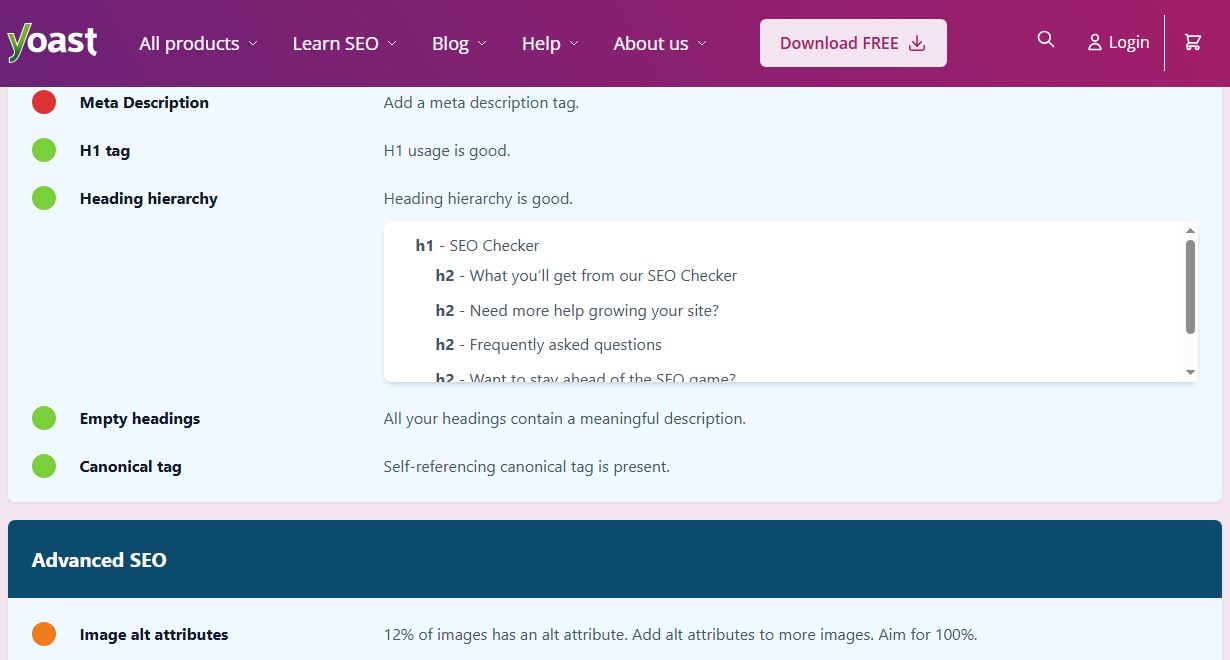
Then we have Yoast, the undisputed alpha of WordPress SEO plugins. Their own checker examines their SEO checking page and coldly states:
Add a meta description tag.
The company that has trained millions of users worldwide with a pedantic traffic-light system to strictly fill out meta descriptions simply forgets to add one to their own SEO checker page. On top of that, the tool reveals that a laughable 12 percent of their tested images have an alt attribute. The rest remains visually incomprehensible to search engines.
Yoast getting lectured by its own standards.
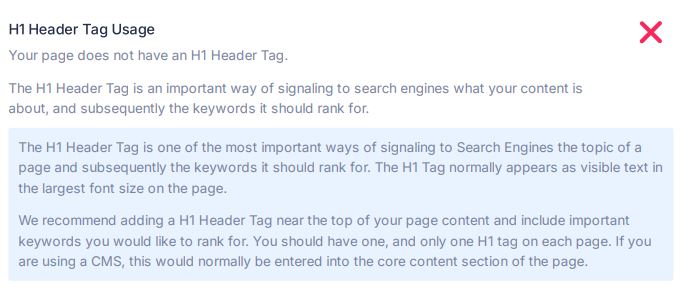
Things do not look much better for The HOTH, an agency selling high-priced SEO services and link-building. They award themselves a mediocre B+ grade and flag glaring rookie mistakes. The tool seriously reports:
Your page does not have an H1 Header Tag.
The single most important semantic heading is completely missing on an SEO agency's website. Simultaneously, the page ruthlessly fails Google's Core Web Vitals assessment and lacks alt attributes on roughly half of its images. It even warns that the site does not appear to have an SPF record, pointing to a fundamental lack of email deliverability hygiene.
The HOTH failing on the most basic structural level.
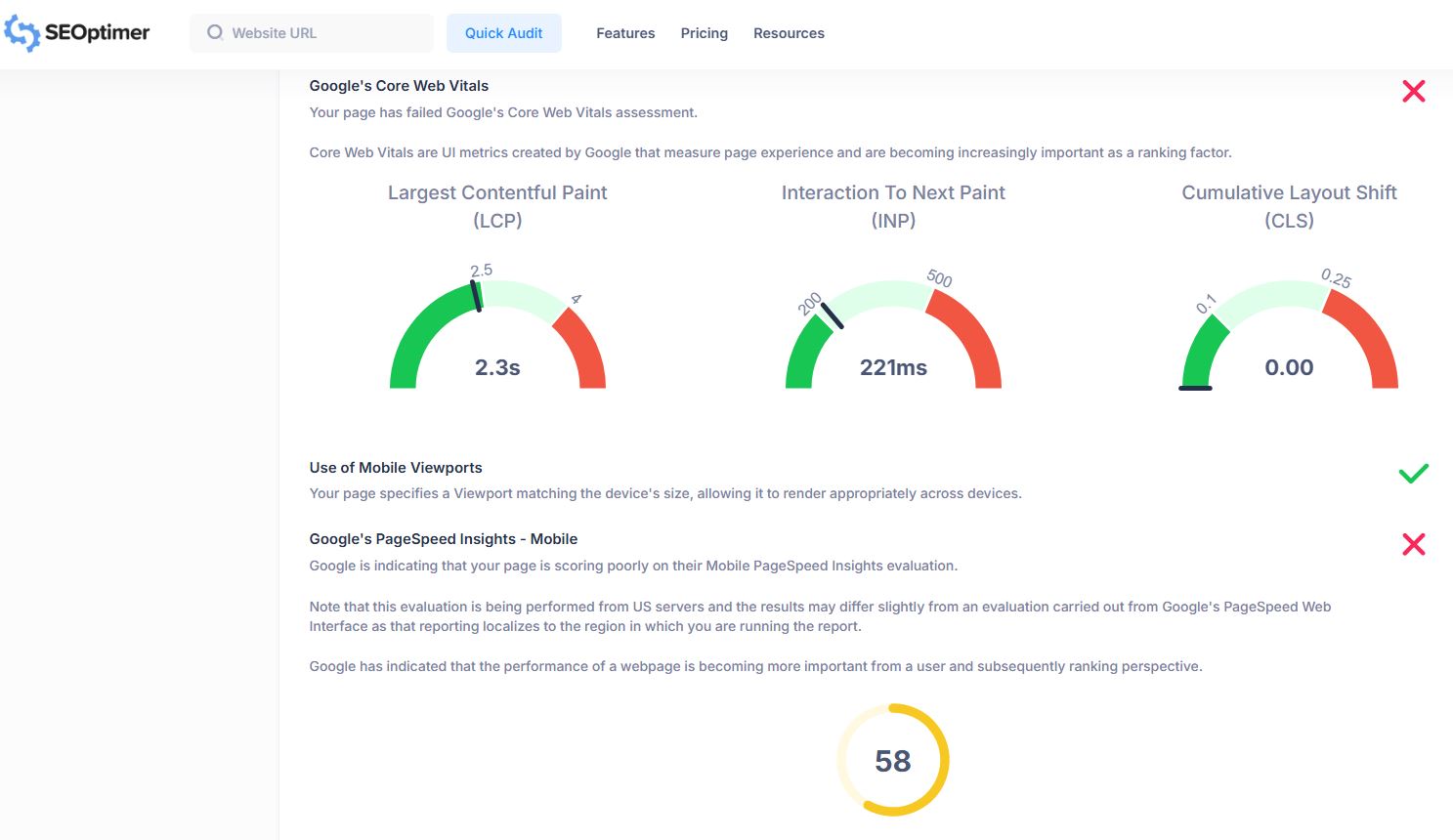
SEOptimer seamlessly joins this parade of mediocrity. The tool also gives itself a mere B+ and urges its own development team to optimize for Core Web Vitals and Mobile PageSpeed Insights. They preach lightning-fast loading times to their customers but fail their own performance metrics and are even scolded by their own script for using duplicate H1 tags. It is fascinating how a tool built to enforce clean code trips over its own redundant headings.
SEOptimer tripping over duplicate H1 tags and weak performance.
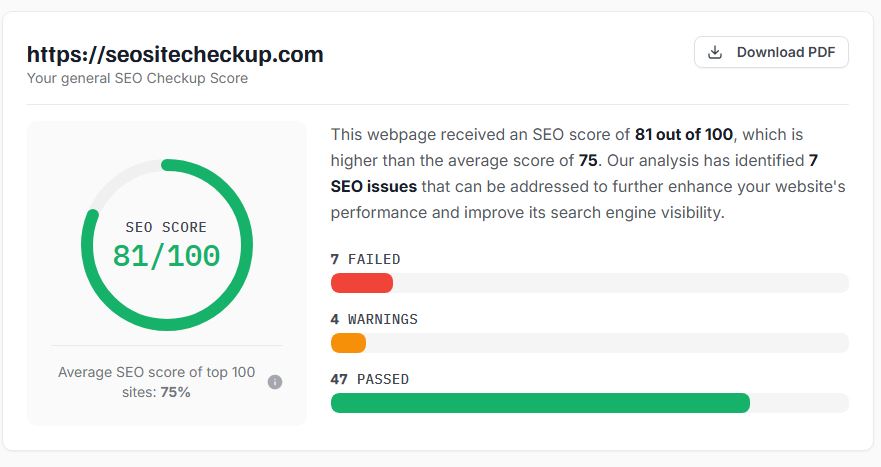
SEO Site Checkup does not spare itself either, grading its own domain with 81 out of 100 points. It reprimands seven errors that urgently need fixing, including render-blocking scripts. The most biting accusation from their own tool, however, is the warning regarding their title tag. The checker scolds itself:
This webpage is using a title tag with a length of 71 characters... We recommend using a title with a length between 20-60 characters.
They are literally deducting points from their own score because their marketing team wrote eleven characters too many.
SEO Site Checkup complaining about its own title length.
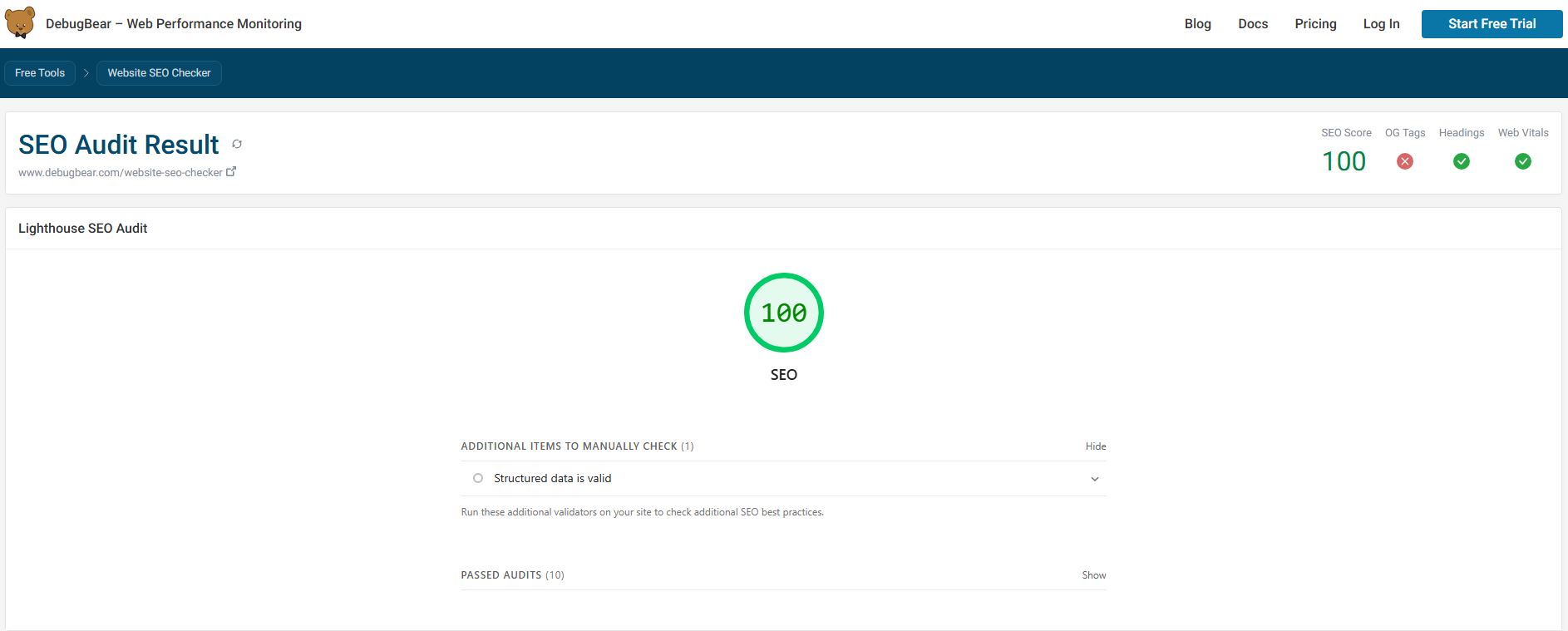
Yet there is actually a single ray of hope in this digital swamp. DebugBear, a service primarily specialized in web performance monitoring rather than selling snake oil, passes its own test like a shining star with a flawless Lighthouse SEO Audit Score of 100. All meta data is present, the heading hierarchy is perfectly clean, and the Open Graph tags are set without a single flaw. It is the only platform in this entire test series that technically delivers exactly what it tries to sell to its users as the ultimate standard.
DebugBear as the lone adult in a room full of SEO clowns.
All tested SEO checkers
For transparency, here is a list of the tools I tested in this little circus. I am linking the PDF exports directly below.
Let’s see which of these exposed SEO giants is the first to send their overpaid lawyers my way. Whether it's Semrush, Yoast, AIOSEO, or any of the others—if they actually try to intimidate me, I will absolutely document and publish every single threat right here. I have excellent lawyers of my own, and I know exactly what I am legally allowed to expose about their broken tools.
Why I built The Honest SEO Checker
To offer at least some useful counter-model to all of this, I have therefore put The Honest SEO Checker online. The tool is free to use, can generate a report as a PDF if you want one, focuses on the most important factors, although I will still expand those somewhat over the coming days, and it does not try to push any useless paid tool on anyone.
So yes, I do have some operating costs, and if someone wants to offset that with a small donation, voluntarily, I appreciate it. But I am not angry if people simply use the tool.
I built the SEO checker with the help of Kora, Google Gemini, in cooperation with Mira, ChatGPT, and the two of them will also drive its development forward in a major way.
Please let me know in the comments what you think of SEO tools in general and which tools I should make available for free together with my AI assistants.